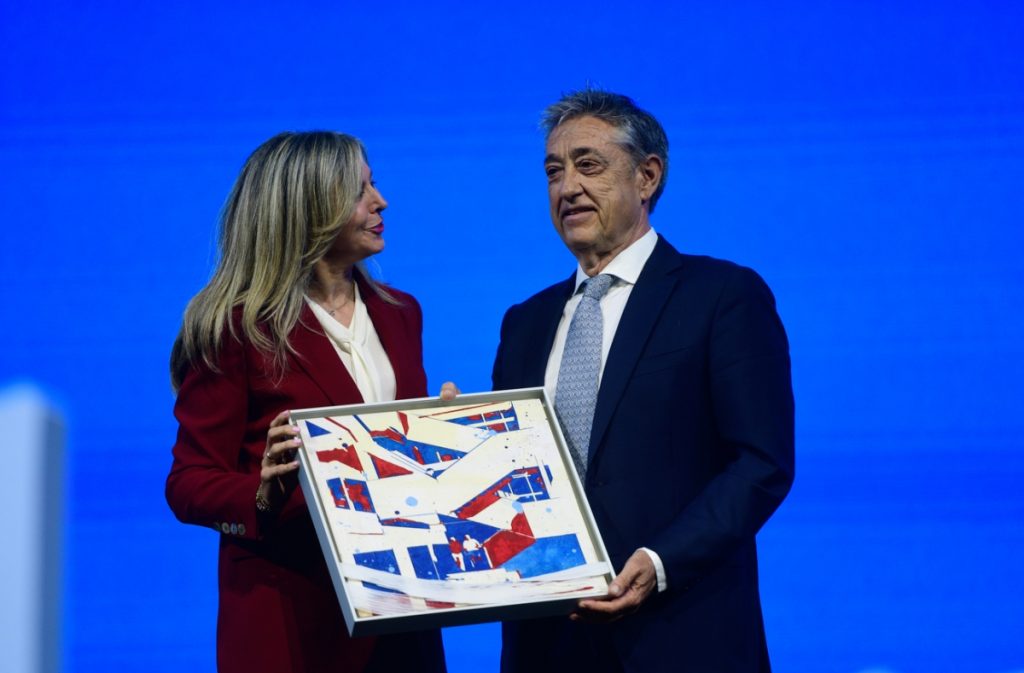
Olallo Villoldo: “We need a calm debate on renewables; there’s too much sectarianism and politics involved”
February 2025
The chairman of Grupotec laments that “sectarianism” has prevailed over “pragmatism” in the debate on renewables and points out that the alternatives to solar power are nuclear energy and gas-fired power.
The importance of the team
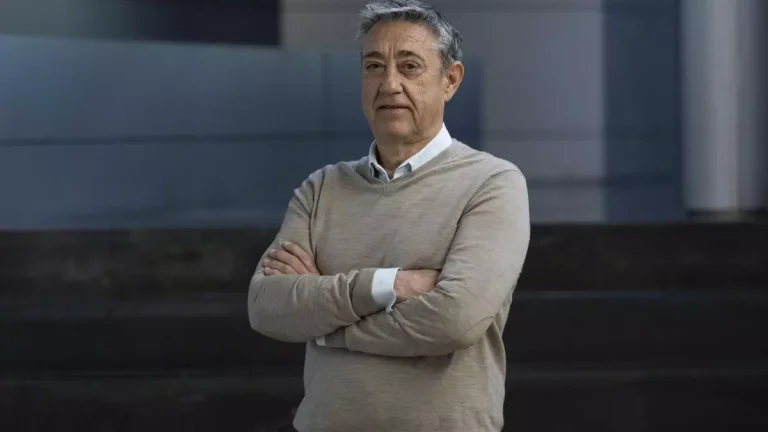
Olallo Villoldo (El Bonillo, Albacete, 1961) is the son of a farmer and an enterprising mother who ran a shop in their village, a municipality in La Mancha with 3,000 residents. At the age of 13, he moved into one of his brothers’ flats in Valencia to study for his A-levels and a degree in agricultural engineering. “That’s what people did there. You either stayed in the area with few prospects or left to study,” he admits. After completing his degree, he set up an engineering firm with a team of twenty people, which became the seed from which Grupotec grew. At that point, he decided to expand the company into various business areas and gave equity stakes to the managers who would head up each of these divisions. “That idea proved to be a success because it has helped the company get to where it is today. If the company had relied solely on my own abilities, it wouldn’t have come this far,” he admits.
Villoldo says his professional outlook changed when he realised that engineering “wasn’t about doing double integrals or complicated things, but about people”. The founder of Grupotec emphasises that it was at that moment he realised engineering had a long way to go. “The key is to engage, motivate and bring the best people on board for your project,” he stresses. Grupotec closed last year with a turnover of 250 million and 658 employees.
How did the storm affect you and how have you responded?
Fortunately, from a business perspective, we were hardly affected. What did affect us, however, was our identity as Valencians and as a company that believes it has a responsibility towards its local community. We quickly mobilised our team. We set up a fund to raise money amongst our staff, with the commitment that the company would match the total and a bank’s foundation (Mediolanum) would match it again. Our staff pitched in and it was a success. We donated nearly 400,000 euros. A second initiative was to provide on-the-ground assistance. We put together a team of 30 people who spent a month and a half pumping out water using pumps we sourced from wherever we could find them, such as Albacete and Teruel.
The early days
You started out in the 1990s as an engineering firm working on projects in the agri-food industry, which evolved into a major renewable energy company. When did you make the transition?
Eighty per cent of our current business comes from renewables and the remaining 20 per cent from engineering related to industry, food, wastewater treatment and architecture. Our commitment to renewables dates back to 2005, when the industry began to develop in Spain with the support of government grants. We realised that the sector fitted perfectly with what we were doing (engineering) and that it was very promising. From the outset, we focused on photovoltaics. It was a rapidly growing market, but before long the renewable energy crisis hit. The approach shifted from promoting renewables to effectively shutting them down. Not only were the subsidies scrapped, but the installation of renewable energy systems was also banned.
Yes, they even went so far as to pass the ‘sun tax’.
Exactly, the ‘sun tax’. The market got off to a very turbulent start in Spain. It went from zero to a hundred in no time, until a bubble formed. At that time, the way the photovoltaic sector was developing made no sense at all because it was an extremely expensive form of energy and you have to start off in moderation. As it grew so rapidly, the situation became unsustainable, and then a decree was issued that slashed feed-in tariffs and put an end to permits and authorisations. This created a market vacuum that wiped out 80 per cent of Spain’s photovoltaic energy companies. At that point, we decided to expand into other markets and moved to the UK in 2010.
To read the full interview, please visit the following link:
https://www.levante-emv.com/economia/2025/02/22/olallo-villoldo-renovables-falta-debate-sereno-114555050.html